Reality Always Wins
Why every attempt to centrally plan society eventually collides with the facts its architects chose to ignore.

One of Ayn Rand's most enduring observations was:
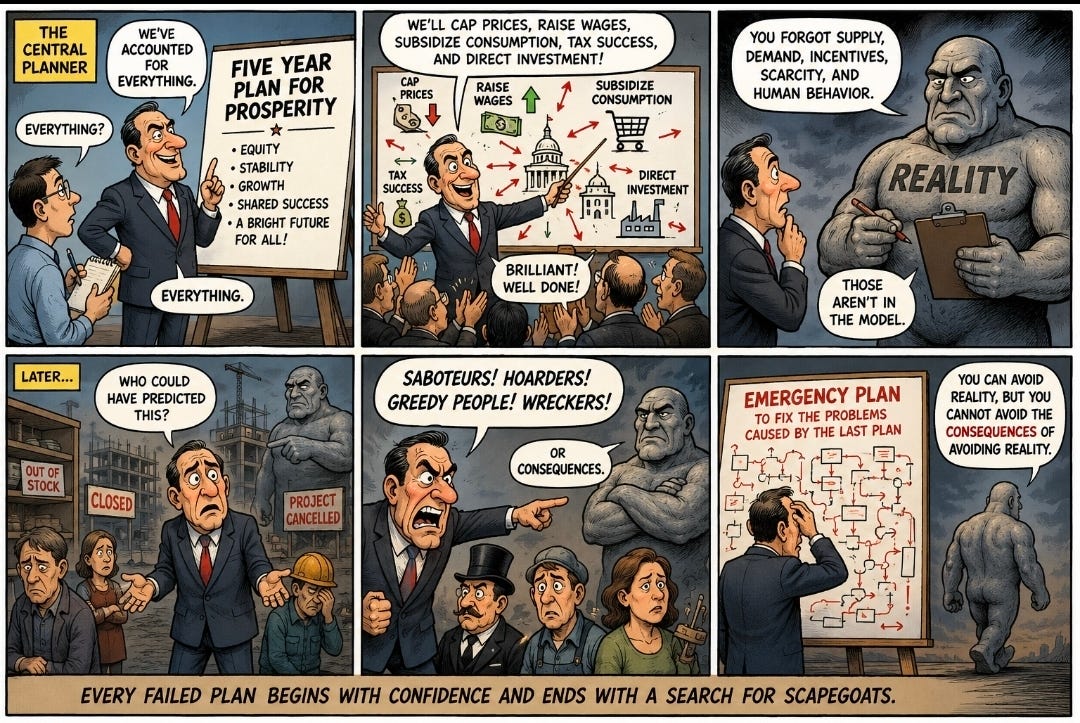
"You can avoid reality, but you cannot avoid the consequences of avoiding reality."
Few ideas better describe the history of central planning.
Every generation produces people convinced that society's problems exist because reality has not yet been sufficiently overruled by good intentions. Prices are too high? Control them. Wages are too low? Mandate them. Housing is too expensive? Restrict, subsidize, regulate, and direct. Production is inadequate? Create a plan.
The planner's confidence is always impressive.
Reality's response is usually more impressive.
The recurring pattern is remarkably consistent. First comes the promise. Experts assure the public that a new plan will create fairness, stability, affordability, or prosperity. Then comes the implementation. Incentives are ignored. Scarcity is ignored. Human behavior is ignored. Supply and demand are dismissed as outdated excuses for greed.
The assumption is always the same: if reality refuses to cooperate, reality must be wrong.
But reality does not negotiate.
A price ceiling does not create more supply because politicians prefer lower prices. A wage mandate does not create more productivity because voters desire higher incomes. Subsidies do not eliminate costs. Debt does not disappear because future generations are politically voiceless.
For a time, the consequences can be hidden. Borrowing can disguise overspending. Inflation can disguise spending. Regulations can disguise shortages. Scapegoats can disguise failure.
But only temporarily.
Eventually reality sends the bill.
And when the bill arrives, the planner rarely blames the plan.
The fault is assigned to greedy businesses, selfish consumers, speculators, hoarders, wreckers, insufficient funding, misinformation, or political enemies.
Anyone but the planner.
That is why failed plans so often produce demands for even larger plans. The original premise cannot be questioned because doing so would require admitting that reality was right all along.
The irony is that central planning is often presented as practical while markets are portrayed as chaotic. Yet markets are nothing more than millions of individuals adjusting to reality every day. Prices change because conditions change. Businesses succeed or fail because consumers decide. Investments flow toward what people value.
A market is a constant process of adapting to reality.
Central planning is an attempt to substitute the planner's wishes for reality.
One learns. The other commands.
One adjusts. The other insists.
And when reality wins, as it always does, the planner discovers Rand's lesson the hard way.
You can avoid reality.
But you cannot avoid the consequences of avoiding reality.
That may be the most important economic lesson ever written.
Reality is the ultimate judge. Great article.